
What happens when we bring duration back into frame? What becomes visible when an event is extended beyond its immediate appearance, when a consequence is brought back beside its cause, when what is supposedly past is placed in proximity to the present, or when different scales of time are allowed to occupy the same frame?
‘First Cut’, Curatorial Framework
We experience time as though it were a neutral condition. A sequence through which events occur, circulate and are replaced; a common measure that allows us to situate ourselves in relation to what has happened and what is to come. Coherent, natural, inevitable. The timeline is an apparatus of intelligibility, an infrastructure of capital.
Capital produces a historically specific temporal order through which relations can be severed and compressed. Within this order, urgency is produced as a measure of what demands attention, and what cannot enter that measure recedes from view. What can be immediately apprehended is given prominence, and acquires visibility. Relations whose significance unfolds across uneven durations or temporal registers become harder to perceive. An event can be made to exist within the moment in which it is encountered, while the duration that makes it consequential falls out of frame.
What happens when we bring duration back into frame? What becomes visible when an event is extended beyond its immediate appearance, when a consequence is brought back beside its cause, when what is supposedly past is placed in proximity to the present, or when different scales of time are allowed to occupy the same frame?
What kinds of time become perceptible when we attend to the formal and material conditions of the photochemical image? To place images together is also to place the times they carry into relation. A cut can sever continuity; repetition can give an instant duration; juxtaposition can bring disparate histories into proximity; –a sequence can produce a relation that was not visible within any single image. To mount is to think through time. Montage is a formal device capable of reconfiguring heterogeneous times and materials. Through revisited configurations, relations, anachronisms, –historical forms can become newly legible.
About Fringe Gallery
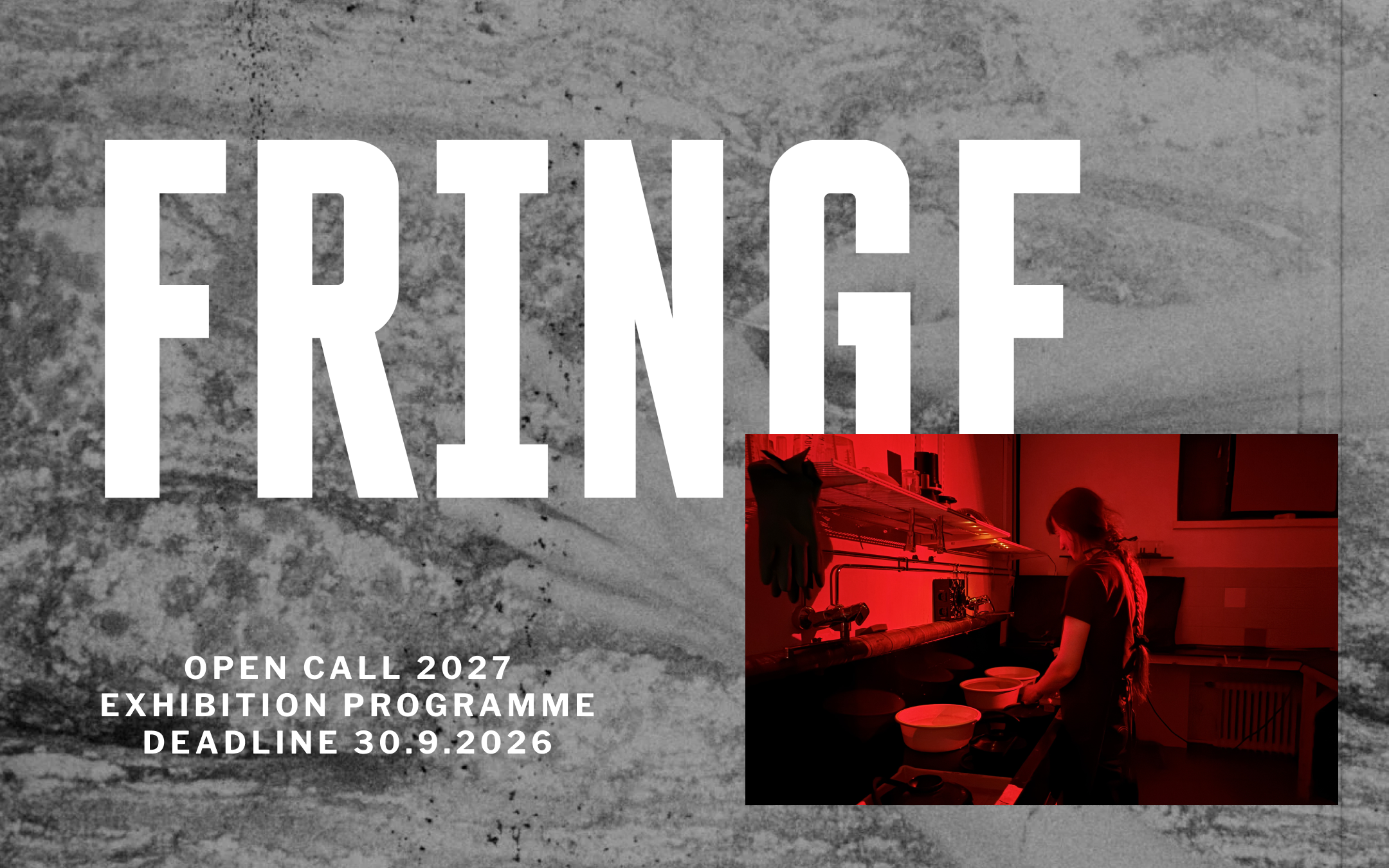
Fringe Gallery is an artist-run exhibition space operated by Filmverkstaden, dedicated to contemporary art practices working with analogue film and photography on photochemical support. The programme explores the possibilities of these mediums through expanded cinema, installation, alternative photographic processes, live and performative forms, and other approaches that exist at the fringes of established image-making. The exhibitions are presented alongside a monthly series of events that complements and expands the programme through film screenings, sound, live cinema, artist talks and lectures.
The gallery occupies a dedicated 70 m² exhibition space adjacent to Filmverkstaden’s facilities at Funkkis, a cultural house in Vaasa. Filmverkstaden is an independent, artist-run centre for artistic production, research and exchange, supporting practitioners working with photochemical film and analogue photographic processes.
Exhibition Programme 2027
The exhibition programme is selected through an annual open call. Applications are first reviewed by members of the Filmverkstaden board, after which the final selection is made by an invited guest curator. For the 2027 open call, the curatorial framework First Cut, developed by Lorena Articardi, will guide the selection process in collaboration with invited curator Kim Knowles.
Each exhibition is presented for four weeks. Installation takes place from Tuesday to Thursday, with the exhibition opening on Saturday at 18:00. Dismantling takes place on the Monday after the exhibition closes.
There is no rental fee for exhibiting at Fringe Gallery.
Production and Support
The artist is responsible for the content and production costs of the exhibition, as well as the transport of works and any necessary insurance. Installation and dismantling are primarily the artist’s responsibility, with assistance from a gallery staff member for one day. Fringe Gallery provides technical support and advice throughout the process.
Artists have access to a range of tools and audiovisual equipment to set up, both analogue and digital. The gallery can be configured either as a white box or as a completely darkened black box, depending on the needs of the exhibition.
During the exhibition period, the gallery takes care of daily cleaning, opening and supervision of the space during opening hours.
Communication and Sales
The artist prepares the written material for the exhibition, including an exhibition text or project description, information about the artworks, artist bio and a CV. The press release is developed in collaboration with the gallery, which also produces and distributes the exhibition invitation and announcement through its communication channels and social media.
For each exhibition, the gallery also produces a video conversation with the artist about their work and working methods, which is published online as part of the exhibition documentation.
Any enquiries about works for sale are directed to the artist or their representative. Artists are also asked to accompany their exhibition with an exclusive limited edition, such as small-scale works, artist books or other artist-made editions or products, which can be offered for sale at the gallery. Fringe Gallery does not take commission on sales.
For its 2027 Programme, Fringe Gallery invites artists working with analogue film and photography to think with the First Cut. To approach images as they are brought into provisional arrangements, where durations are tested and temporal relations reconfigured.
We are looking for practices that engage with time as historically and politically organised, that question what is held in view, and that stay with what falls out of frame as relations and consequences unfold across uneven durations. What kinds of time become perceptible when we attend to the formal and material conditions of the photochemical image? To place images together is also to place the times they carry into relation. A cut can sever continuity; a sequence can produce a relation that was not visible within any single image. To mount is to think through time.
Application deadline: September 30, 2026
For the 2027 open call, the curatorial framework First Cut, developed by Lorena Articardi, will guide the selection process in collaboration with invited curator Kim Knowles.
Montage directs attention and establishes the duration within which a subject can be encountered; arguably a single frame could also perform a montage-like temporal function. Preservation extends that encounter, allowing the image to become evidence, a historical record. As it circulates, it enters infrastructures that condition who encounters it, under what circumstances and for how long. It carries both a sense of immediacy and traces of material process, traces that precede the exposure. The extraction and transformation of the materials from which it is made, the labour and infrastructures that bring it into being. The conditions of production can become separated from the image, as the history that produced an event can become separated from the event itself.
For its 2027 Programme, Fringe Gallery invites artists working with analogue film and photography to think with the First Cut. To approach images as they are brought into provisional arrangements, where durations are tested and temporal relations reconfigured.
What can the material durations of photochemical practices, their processes of waiting, repetition, exposure, development, preservation and decay, allow us to perceive about the political organisation of time? Once disassembled. Once reconfigured, do these temporalities merely coexist? Do they constitute one another? What does it mean to work against an order we cannot simply exit?
What happens when the temporal conditions under which we look are themselves organised by capital? What is held in view, what disappears between frames, what gets repeated until it becomes a reality? What is presented as urgent, and what relations are severed before they can become perceptible? What has been compressed, excluded, naturalised for the photographic image itself to appear as an autonomous object?
Curator 2027
The curator of the 2027 open call is Kim Knowles, whose research and curatorial practice centres on experimental film and the material dimensions of photochemical practice. Her work considers how engagement with film as a physical medium can open up alternative ways of seeing and sensing, while questioning narratives of technological progress, replacement and obsolescence. Her research extends into expanded and intermedial forms of cinema, as well as questions of ecology and non-human representation. She is the author of Experimental Film and Photochemical Practices and was the Experimental Film Programmer for the Black Box strand of the Edinburgh International Film Festival from 2008 to 2022.
Exhibition Periods 2027
Please indicate your preferred exhibition period in your application. While we will do our best to accommodate preferences, final dates will be agreed upon with the selected artists.
– 16th January–14th February
– 27th February–28th March
– 10th April–9th May
– 22nd May–20th June
–11th September–10th October
–23rd October–21th November
How to Apply
Application materials:
– Exhibition proposal (max. 2,000 characters, including spaces), include a response to the framework outlined in the open call.
– Visual material (3–5 images)
– CV and Portfolio, or a link to an online portfolio.
– Contact information and preferred exhibition period/time slot.
Please combine all application materials into one PDF (max. 10 MB) and name the file Firstname_Lastname.
Send your application by email to mail@filmverkstaden.fi with the subject line “First Cut – Fringe 2027”.
Application deadline: September 30, 2026
Each application will be acknowledged as received.
We look forward to receiving your applications!
Contact
Lorena Articardi
Head of Programme and Operations
Filmverkstaden rf / Fringe Gallery
+358 40 360 3834
mail@filmverkstaden.fi